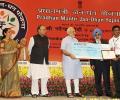
Government's financial inclusion mission is well intentioned, but it may be putting a severe strain on the banking sector.

Why, centuries after the French Revolution promised an end to feudalism, do political dynasties persist -- even in democracies, asks Ajit Balakrishnan.
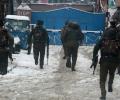
'We need to be in a perpetual state of aggression, and able to swiftly change the goal posts to keep Pakistan in a state of imbalance,' argues Sanjeev Nayyar.

A European-led boycott of FIFA or the World Cup is unrealistic.
Chartered accountant and commentator M R Venkatesh on why the GST Bill will cost the BJP dear.

'What has he done for the state and the people?' 'The state has witnessed extraordinary problems. Where was he then?' 'Has he spoken about any issues or taken a stand?'

The prime minister's August 15 address was undoubtedly inspirational and outlined important economic and social objectives, such as making India a global hub for manufacturing, ensuring bank accounts for all poor families, major thrusts in sanitation and cleanliness, and a radical restructuring of the Planning Commission.

'Communal tension and violent mobs have been part of our country, whichever government is in power. What has happened since the BJP came into power is that individuals or group activities asserting Hindutva have become louder, more aggressive.' 'Now we are finding ourselves in a country where reasoning and thinking have no place, the power lies with the goons.' 'I find any ban, whether on what we write, what we eat, how we dress etc, absolutely abominable. They have no place in a democracy.' Shashi Deshpande on why she joined the writers' protest against the growing intolerance in India.

'...incarcerated in jails, ruining their entire families.' 'You would see that Dalits who displayed so much agitation over the Bhima-Koregaon issue are effectively silenced by the arrests of their activists by the police.' 'What can be a more pitiable state than this for a people who had just seen a ray of hope after darkness of millennia?'

US President Barack Obama's administration has faced extensive criticism for its failure to prosecute bankers criminally for behavior that led to the financial crisis.
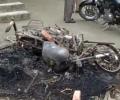
'The horrific episode of January 18 in Muzaffarpur, Bihar, is quite different from what happened in Muzaffarnagar, UP, in September 2013. The Akhilesh Yadav-led administration in UP and riot-mongers among our political formations need to learn lessons from the response of the state and society in Bihar's Muzaffarpur,' says Mohammad Sajjad.

'Diplomatic engagement will continue even as India keeps all its options open with respect to discretely targeting the Pakistani military and its terrorist proxies.'

'When he first came to office, my belief is that the PM's reading of the landscape was that, with a vanquished Congress and fragmented Opposition, he was looking at least at two terms in office. This reading perhaps allows for a more cautious, gradual approach.' 'It was only a matter of time before the government was forced to come face-to-face with a serious corruption scandal. This is not a commentary on the BJP, but a statement about India's political economy.' 'There is growing concern about the government's commitment to freedom of expression, religious tolerance, and an independent civil society. Thus far, the positive movement on strategic and economic matters has crowded out these concerns, but they are lingering beneath the surface.'

The chief of America's Federal Communications Commission is not a fan of net neutrality. So what's his vision of communications and digital policy in these times?

The fiscal deficit of the Centre remains a worry, running at over 6.5 per cent of GDP in April-September 2014, mainly because of revenue shortfalls from exaggerated projections in the government's July Budget and despite the relief on subsidies from lower oil prices.

The toxic brew of fiscal populism, crony capitalism and bad economic management has ensured the collapse of economic growth, industrial stagnation, stubbornly high consumer inflation, declining savings and investment, shrinking employment opportunities, and a dangerously vulnerable external financing situation.

Rohith, like Mahatma Gandhi, was not allowed to speak the truth by the forces who killed him, said Congress vice president.

'The darkest days of Indian democracy were (during) the Emergency when basic democratic rights were suspended. For a time it seemed as though India would move along the East Asian model -- everybody works hard, nobody asks questions, certainly not of the government.' 'There are people who say we are headed that way, but I am not persuaded by the evidence,' says Mahesh Rangarajan who recently resigned as director of the Nehru Memorial Museum and Library in New Delhi.

After many false starts, India may well be at the inflexion point that Deng Xiaoping took China to post-1978. The window of opportunity is wide open right now, says Rajeev Srinivasan.

With facts and figures, the CAG report has highlighted how Gujarat was far from a role model for states across India, and that the progress made in this province in western India in improving agriculture, education, healthcare and empowerment of women and children, was not exactly creditable, says Paranjoy Guha Thakurta.

'Today if you look at the way India is growing many people are saying the sleeping elephant has finally woken up, is dancing!' 'I have travelled extensively, in about 60 countries. In all these the moment you say India, the first thing they mention is either an actor's name. Or they start humming a song.' 'I wanted to be in Bollywood. It is the most powerful medium we have in this country. That's soft power.' Listening in on Shobhaa De, Kabir Khan, Vikas Swarop and Saffron Art CEO Hugo Weihe speak on India's Soft Power, Hard Influence.

Judge Srikanth 'Sri' Srinivasan is the front-runner to replace the late Justice Anthony Scalia on the US Supreme Court.

'I've answered all those people who are tweeting nonsense about Varnika Kundu and trying to shame her.' 'Shame her for what? For being a young girl at a party with friends? For enjoying herself?' 'I think it is ridiculous for somebody to say that she should not be out at night.' 'Why should a girl not step out at night?' 'What does that mean?' 'Does it mean that something happens to the boys at night and they change into monsters?' 'If so, then the problem lies with the boys, not with the girls.' 'Please keep your sons at home at night.' 'Why are you telling girls where to go and what to do?'

'There was a time when I went without salary for about six months,' says Amod Malviya, an alumnus of IIT Kharagpur and currently CTO, Flipkart.

'Prime Minister Manmohan Singh refused to allow us to project his real personality to let the people of India know exactly what he really was. He was always shying away from greater public exposure. Since the last two years we have seen enormous criticism, ridiculing the prime minister. He has been made into an object of jokes. It certainly hurts. I think this man deserves lots of good reviews... His contribution to social policy, his contribution to the economy, his contribution to coalition management, his contribution to foreign policy.' Dr Sanjaya Baru, Dr Singh's former media advisor who is in the eye of a storm over his book on the prime minister UPA speaks to Rediff.com's Sheela Bhatt.
